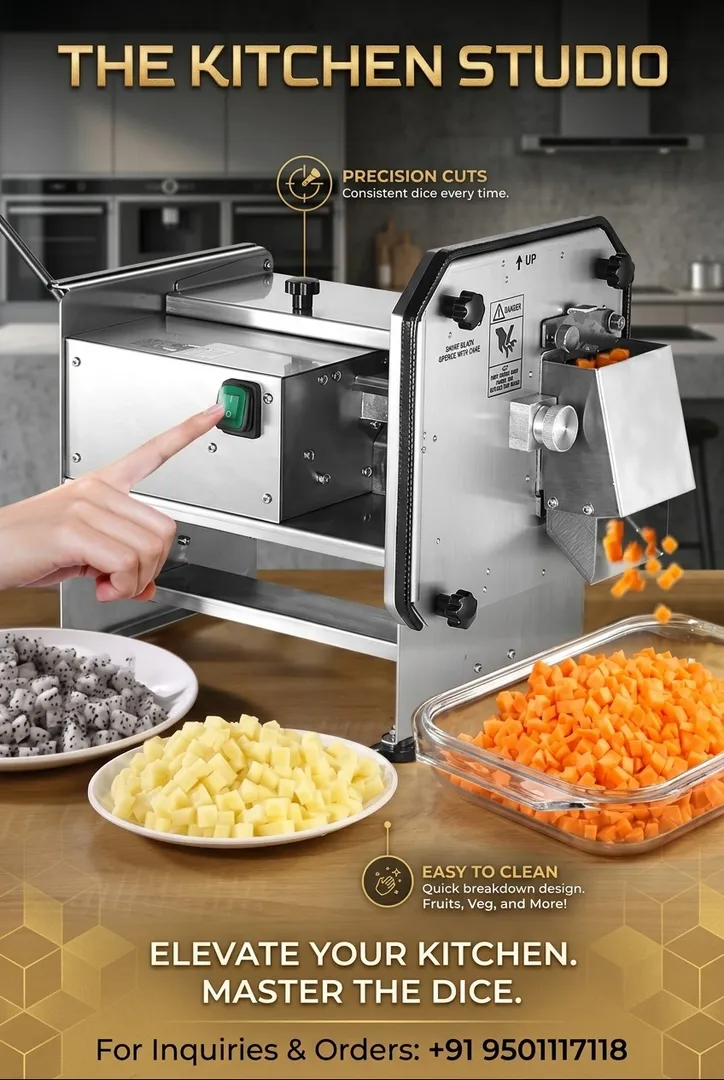
Manual cutting can consume a significant amount of preparation time in kitchens that process vegetables and fruits in large quantities. A Commercial Vegetable and Fruit Dicing Machine can help standardize cutting while reducing repetitive preparation work in restaurants, hotels, catering kitchens, central kitchens, and food-processing operations.
The value of such a machine depends on selecting it according to the ingredients, required cut size, production volume, and cleaning routine.
Determine What Ingredients Will Be Processed
Not every vegetable and fruit has the same texture.
Firm produce, soft fruits, leafy ingredients, and high-moisture items can behave differently during mechanical cutting.
Before selecting a machine, operators should list the main products they expect to process and verify whether the equipment is designed for those applications.
For commercial kitchens in Mohali, this can be especially useful for operations preparing large quantities of vegetables for daily meal production, catering, or institutional food service.
Define the Required Cut
Uniformity is one of the main reasons businesses consider dicing equipment.
Consistent pieces can support predictable cooking times and cleaner presentation. However, the machine needs to produce dimensions that suit the menu.
Operators should check available cutting assemblies and determine whether different sizes can be achieved when the menu requires flexibility.
Calculate Daily Processing Volume
A machine should be sized according to real workload.
Estimate how many kilograms of produce are currently processed manually each day and how much time staff spend on the task.
This provides a more meaningful basis for evaluating machine capacity than relying solely on maximum output figures.
Peak-day requirements should also be considered for catering operations and establishments with fluctuating demand.
Assess Cleaning Convenience
Food particles can become trapped around cutting components if equipment is difficult to disassemble.
Operators should understand which parts are removable, how cutting assemblies are cleaned, and how long routine cleaning takes.
Easy access is particularly important when different ingredients are processed throughout the day.
Review Safety Features
Cutting machines contain moving components, making safe operation essential.
Equipment should provide suitable guards and operating controls, while staff should be trained in correct feeding, cleaning, and shutdown procedures.
Cleaning should only take place according to the recommended safe procedure.
Consider Space and Workflow
The machine should be positioned where washed produce can reach it easily and diced ingredients can move directly to the next preparation stage.
Placing the machine far from washing and preparation areas can reduce the time savings it was intended to create.
The Kitchen Studio supplies commercial food preparation equipment alongside broader kitchen planning solutions. When choosing processing machinery, looking at the complete preparation workflow can help businesses select equipment that genuinely reduces labour-intensive steps.
A commercial dicing machine makes the most sense when a kitchen processes sufficient quantities of suitable ingredients on a regular basis. Consistent cutting, reduced manual preparation, and faster batch handling can then contribute to a smoother production process.
Before purchasing, businesses should evaluate ingredient compatibility, cutting requirements, capacity, cleaning access, safety, and available workspace. Equipment chosen around those practical factors is far more likely to become a useful part of everyday kitchen operations rather than an underused machine occupying valuable preparation space.
Keywords