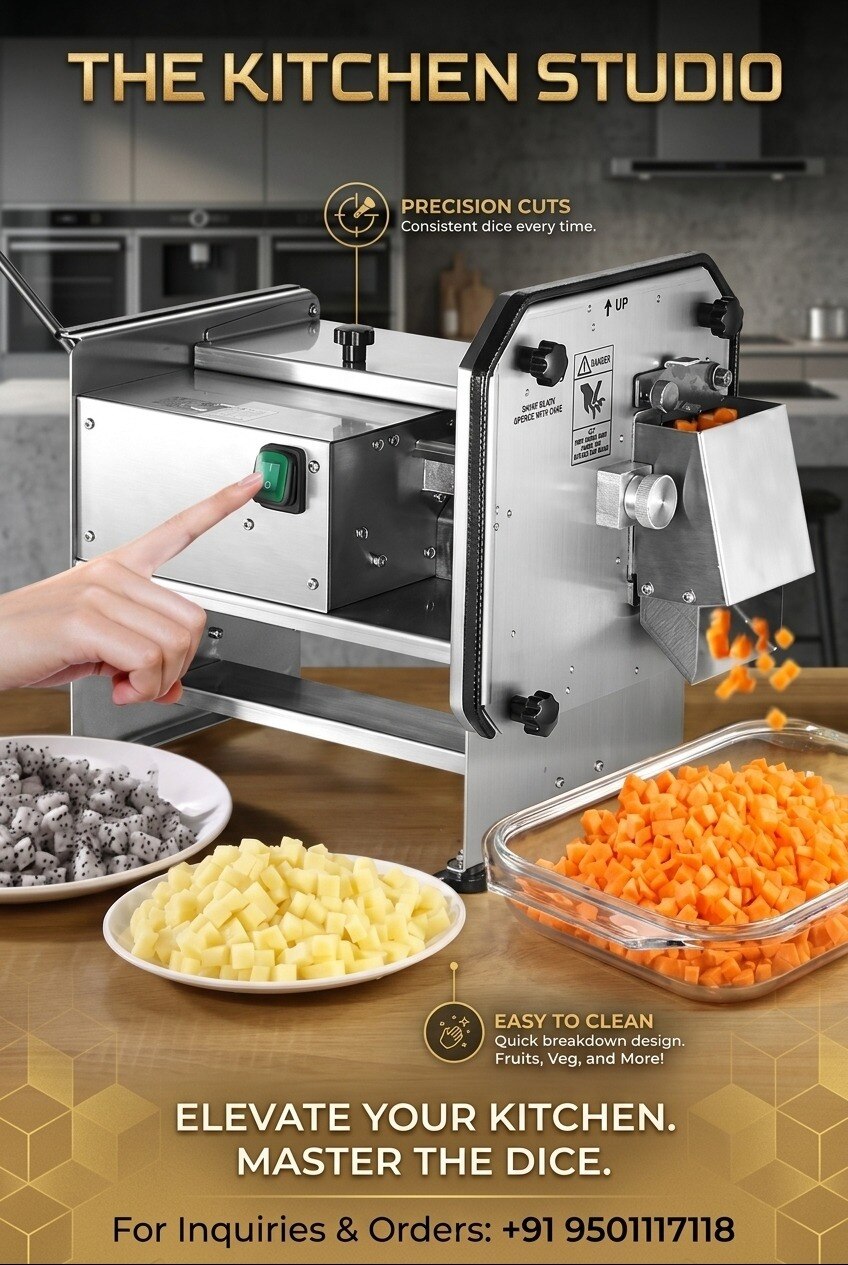
The correct machine capacity comes from your busiest preparation period, not the largest kilogram figure in a catalogue. By calculating usable output, testing your actual produce and allowing for downtime, you can specify a dicer that keeps pace without paying for an oversized model.
Key takeaways
- Divide required volume by your peak preparation hours, not the full operating day.
- Compare usable throughput with the advertised rate under your actual product and cut conditions.
- Test firm, soft and irregular produce before approving the machine.
- Specify headroom above peak demand to absorb delays, cleaning and product variation.
Calculate Capacity from Your Peak Preparation Window
Convert daily vegetable volume into peak-hour demand before choosing a machine. If you need 400 kg during a two-hour preparation window, your net requirement is 200 kg per hour, not 400 kg divided across the whole operating day.
Allow for time when the machine is not cutting. With 70% productive utilization, including loading, product changes, clearing, and operator pauses, divide 200 by 0.70: the required machine rate is about 286 kg per hour. Replace the 70% assumption with measured utilization from your kitchen; washing, trimming, and frequent knife changes can reduce it further.
Use this checklist to calculate the commercial vegetable and fruit dicing machine capacity you actually need:
- Record the kilograms or crates required for each major product during the busiest preparation period.
- Convert crates to kilograms using your actual average crate weight, not the supplier’s estimate.
- Identify the slowest product to prepare, including washing, trimming, pre-cutting, and loading.
- Add the labor and equipment time needed to cut large potatoes, cabbage sections, melons, or trimmed fruit so they fit the feed opening.
- For a batch dicer, verify maximum recommended product weight separately from hopper volume; the motor, knife-grid clearance, and product movement limit usable batch size.
- Compare the required rate with the supplier’s sustained production rate, not its brief peak or empty-machine rating.
Size for the difficult major product and leave operating margin for seasonal demand, knife wear, and staff-dependent feeding. A machine matched exactly to today’s average can become tomorrow’s bottleneck.
Use Usable Throughput Instead of the Advertised Rate
A machine rated at 300 kg/h will not necessarily give your kitchen 300 kg of acceptable dice each hour. Rated throughput is a test result under defined conditions, including the product, dice size, feed method, loading level and product temperature.
Plan with usable throughput: the saleable diced product delivered after normal interruptions. The most useful figure is the sustained production rate measured across a realistic run, not the short peak achieved with uninterrupted feeding and a full hopper.
Ask the supplier to state:
- The rated throughput and the exact product used for the test.
- The sustained production rate over a specified run length.
- The feed method, product temperature, dice size and operator involvement.
- The maximum hopper volume and recommended batch size by product weight.
A batch dicer’s hopper volume is not automatically its usable batch size. Excess loading can overload the motor, restrict movement into the cutting head or leave product trapped around the knife grid. Request the maximum recommended weight, not only the hopper’s litre capacity.
Measure yield alongside speed. Product retained in the feed chamber, trapped in the grid, removed during trimming or rejected for poor shape reduces the value of a high gross rate. A slower machine that produces more saleable dice can deliver the better working capacity.
Use trial results from your own produce to set the dependable figure.
Match the Machine Type and Cut Specification to the Work
Choose a small-batch dicer for intermittent preparation, a continuous-feed dicer for repeated production through a service period, and an industrial high-throughput dicer when large volumes must run with minimal operator loading.
| Option | What it means | When it applies |
|---|---|---|
| Small-batch dicer | Loads product into a hopper or chamber; capacity depends on usable batch weight, not hopper volume alone | Several short preparation runs, varied products, or output measured in batches |
| Continuous-feed dicer | Product enters through a controlled hopper or conveyor and exits continuously; compare sustained kg per hour | Repeated runs of one or two products during a defined preparation window |
| Industrial high-throughput dicer | Heavy-duty feed, drive and cutting assemblies support long production cycles | Central kitchens, processors and operations with high daily volume and limited changeover time |
Ask for the maximum recommended product weight as well as hopper volume. Excess loading can overload the motor, restrict product movement or damage the knife grid.
A 6 mm dice usually runs differently from a 10 mm or 20 mm dice. Smaller cuts require more grid work and can create more fines or compression damage, reducing saleable output.
Specify the product, slice thickness, grid opening and feed orientation in every capacity quotation; a compatible grid may still need a separate slicing knife.
Treat rated kg per hour as a test-condition figure. Irregular, soft, oversized or chilled produce, manual feeding, trimming and cleaning reduce sustained production. Measure acceptable diced output, fines, purge and retained residue, not gross feed alone.
Test the Difficult Products Before You Commit
A product trial exposes the gap between a machine’s brochure rate and the kilograms you can sell. Test the actual vegetables or fruit, in the condition you will process them, using the knife, grid and feed method specified for production.
1. Bring representative product, including the awkward pieces: soft tomatoes, fibrous peppers, oversized onions, chilled potatoes or irregular fruit. Record its temperature, preparation, input mass and whether an operator loads it by hand or a conveyor feeds it.
2. Run the same product through the required settings for a 6 mm dice, 10 mm dice and 20 mm dice. Confirm the complete cutting sequence: slice thickness, grid opening and feed orientation. A machine that accepts the grid still might need a separate slicing knife for the finished size.
3. Measure gross throughput and cut uniformity at each setting, not just the time to fill a container. Count pieces that are crushed, torn, oversized or undersized, because smaller dice demand more knife-grid work and can create more fines.
4. Weigh acceptable diced output, fines, purge, trimmed waste and product retained in the feed chamber or grid. Divide saleable output by input mass to calculate yield; a slower run with 92% saleable yield can beat a faster run that delivers 75%.
Request sustained results for your product and exact cut, including knife condition. Repeat the trial with service-worn knives if possible, then price replacement knives, sharpening and spare grids before accepting the quoted capacity.
Build Headroom into the Final Equipment Specification
Specify capacity headroom against the slowest difficult major product, not the easiest high-volume item. A machine that handles 400 kg/h of firm potatoes may fall behind on cabbage, melon, or soft fruit, especially when feeding depends on one operator. Include seasonal demand, menu changes, staff absence, and simultaneous preparation in the margin.
Make the quotation identify the exact knife grid, slice thickness, and product rate. A 6 mm dice can run differently from a 10 mm or 20 mm dice because smaller cuts demand more grid work and create more fines.
Confirm whether large potatoes, cabbage sections, or melons must be trimmed or pre-cut to fit the feed opening, then count that labour and equipment.
Treat knife wear as a capacity loss, not only a maintenance issue. Dull knives increase compression, tearing, fines, and motor load. Ask for knife replacement cost, sharpening policy, expected service life, and spare-grid requirements. The Kitchen Studio can help you check whether the proposed machine layout leaves enough access for these service tasks.
Before approval, verify the installation against the actual site:
- Nameplate voltage, phase, frequency, full-load current, and disconnect specification
- Floor space, hopper height, discharge clearance, and access for cleaning
- Drainage, wash-down arrangements, and safe clearance from adjacent equipment
- Whether staff can remove the hopper, knife assembly, and guards without stopping nearby production
A correctly sized machine still becomes a bottleneck if operators cannot load it safely or maintain it during the service day.
Frequently asked questions
How do you calculate the required dicing machine capacity?
Divide the total produce volume needed during your peak preparation window by the available preparation hours. For example, 400 kg prepared in two hours requires 200 kg per hour before adding headroom.
Why should you use usable throughput instead of the advertised rate?
Advertised throughput may not reflect your produce, cube size, feed method or interruptions. Compare output from a practical test using the products and cut specification you will actually process.
What should you test before choosing a fruit and vegetable dicing machine?
Test the products that create the most difficulty, including firm, soft and irregular items, and check both cut consistency and actual output during the required preparation window.
How much capacity headroom should a final equipment specification include?
Specify capacity above your calculated peak-hour requirement so the process can absorb loading delays, cleaning, product variation and other interruptions. Set the margin after testing usable throughput.