Four burners do not guarantee four productive cooking stations: output, pan spacing, gas supply, ventilation and operator access determine whether the range keeps pace during service. By the end, you will be able to calculate the range’s real capacity, identify installation requirements and write a specification that suppliers can answer with measurable details.
Key takeaways
- Count active pans before choosing burner quantity.
- Check gas pressure, supply capacity and exhaust requirements before ordering.
- Choose removable grates and accessible surfaces for faster sanitation.
- Specify dimensions, output, recovery and safety details in writing.
Measure Throughput by Burner Output, Pan Space and Recovery
A 4-burner commercial gas cooking range can handle your volume only if its usable pan space and recovery speed match your busiest service period. Start with the number of pans you need active at once, not the number of burners on the specification sheet.
Record these figures for each burner:
- Burner output in BTU/h at maximum and minimum settings
- Pan diameter allowed without handle collisions or blocked controls
- Pot footprint available beside and behind adjacent burners
- Time required to return a stockpot or sauté pan to cooking temperature after loading
Do not treat total burner output as usable cooking capacity. Four 30,000 BTU/h burners provide 120,000 BTU/h of gas input, but undersized pans, high grates, poor flame contact and obstructed air can waste that heat. A large burner under a small pan may consume more fuel without shortening the cook.
Test the actual menu during a simulated peak. Run the largest pans you expect to use, load them with normal batch quantities, and measure recovery after adding refrigerated ingredients. If four pans cannot be positioned safely, the range is effectively a two- or three-pan workstation.
Compare recovery results with your order pattern. A range that boils one pot quickly can still create a queue when sauces, stock and sauté orders compete for the same usable pan capacity. Ask for burner-by-burner ratings and a layout drawing before approving the equipment.
Confirm Gas Supply, Pressure and Ventilation Before Ordering
A matching pipe thread does not prove that the restaurant can supply the range safely. Verify the fuel, available pressure, total connected load and exhaust capacity before approving the order.
1. Read the range rating plate and installation manual. Record total gas input, inlet connection size, connection location, required regulator and approved fuel: LPG, PNG or natural gas. A four-burner range with an oven can require more supply than a cooktop-only unit.
2. Ask a licensed gas fitter to size the line for the range plus every connected appliance. The calculation must include developed pipe length, allowable pressure drop, pipe material and local fuel-gas code. Do not size the line from the appliance connection alone.
3. Measure dynamic pressure at the appliance inlet while other equipment operates. Typical references are about 5 inches water column for natural gas and 10 inches for propane pressure, but the rating plate controls. LPG and natural gas need different orifices, regulators and settings; never drill or swap jets without the manufacturer’s conversion procedure.
4. Confirm the hood’s capture area, exhaust volume, makeup air and combustion-air provisions with the ventilation contractor. An undersized hood leaves heat and combustion products in the kitchen; excessive negative pressure can disturb flames.
5. For casters, specify an approved movable-appliance connector and the required restraint or anti-tip device. Shut off gas before moving the range, then inspect every joint for leaks.
At high altitude, obtain the manufacturer’s approved derating or conversion instructions rather than assuming sea-level performance.
Specify the Frame, Grates and Dimensions for Daily Sanitation
A stainless steel grade does not make a range corrosion-proof. Specify sealed or continuously welded corners, closed tube legs with adjustable feet, and a finish that tolerates the cleaning chemicals you actually use; chloride-bearing cleaners, bleach residue, salt and standing water can pit even good stainless steel.
| Construction detail | Specify | Failure prevented |
|---|---|---|
| Frame | Exact stainless steel grade, sealed joints and rigid cross-bracing | Corrosion, wobble and dirt-filled seams |
| Grates | Level-supported, removable cast-iron grates with adequate burner-well support | Rocking stockpots, uneven heating and cracked supports |
| Spill control | Sloped spill areas, removable drip trays and accessible burner wells | Standing water, grease buildup and blocked servicing |
Set the working height from the finished floor, not the bare slab, and record the overall width, depth, grate height and clearance beneath the frame. Leave enough distance between burner centres for four intended pans; handles that collide force cooks to lift hot cookware across an active flame.
Adjustable feet must level the range without reducing its stability.
- Require an NSF/ANSI 4 sanitation listing when your specification calls for certified commercial cooking equipment; gas-safety certification alone does not establish cleanability.
- Show removable panels, burner-well access and service clearance on the installation drawing.
- Confirm that the footprint, leg clearance, floor condition and hood clearances satisfy local fuel-gas, mechanical, fire and sanitation inspections.
- Obtain the approved cleaning method: remove salt and bleach residue, dry drip trays, and never leave water trapped against joints.
Design the Workstation Around Safe, Repeatable Service
Assign each burner a job before service, based on usable pan footprint rather than the burner’s advertised input. Test the largest stock pots together: burner spacing must leave room for handles, ladles and a cook’s hands without forcing one pan onto an unstable grate or blocking the rear controls.
- Front left: rapid boiling or the highest-load pot.
- Front right: sautéing, where the cook needs frequent access.
- Rear left: sauce reduction or simmering.
- Rear right: a reserve burner for batch cooking, not automatic overflow.
Keep the highest, heaviest vessel on the burner with the best grate support. Do not stack pans across two burners; uneven contact causes rocking, spills and poor heat transfer. Mark repeatable knob positions for common tasks so each shift is not guessing at flame settings.
Specify independent controls with positive low-flame stability, knob protection and a usable simmer control. If the flame goes out during reduction or surges when turned down, cooks will move pans mid-service and create a bottleneck. A four-burner range also needs enough clearance to reach every control without leaning over an open flame.
Never use a low burner as indefinite holding equipment. Keep time/temperature-control-for-safety food at hot holding 135°F (57°C) or above in a listed holding appliance, checking it with a calibrated thermometer; a range flame is not a validated holding system.
Turn the Purchase Into a Verifiable Equipment Specification
Require a signed equipment dossier before approval, not a brochure. The file should identify the exact model, burner input in BTU/h, total input, gas type, inlet pressure, connection size and location, dimensions, clearances, and installation requirements.
1. Request the manufacturer’s data sheet and installation manual. Confirm whether each burner has equal output, list turndown ratings, burner spacing, usable pan clearance, regulator specification, combustion-air needs, hood clearances, and the approved connector and restraint arrangement for casters.
2. Request evidence of gas-equipment compliance under ANSI Z83.11 and CSA 1.8, including the certification mark and model number covered by the listing. Require NSF/ANSI 4 sanitation certification when your specification demands cleanable construction and hygienic food-contact areas; gas safety approval does not replace it.
3. Ask for factory test records or a commissioning procedure covering burner ignition, flame stability at high and low fire, manifold pressure, gas leaks, and recovery after placing a cold pan on the burner. Specify acceptance readings and who records them during installation.
4. Get written answers on high-altitude derating, LPG-to-natural-gas conversion, warranty exclusions, replacement burner parts, and service response. Require local approval against the adopted fuel-gas, mechanical, fire and sanitation codes.
5. If The Kitchen Studio handles commercial kitchen fabrication, have its drawing show service access, leg or caster restraints, gas shutoff location, and hood interface before fabrication begins.
Related product
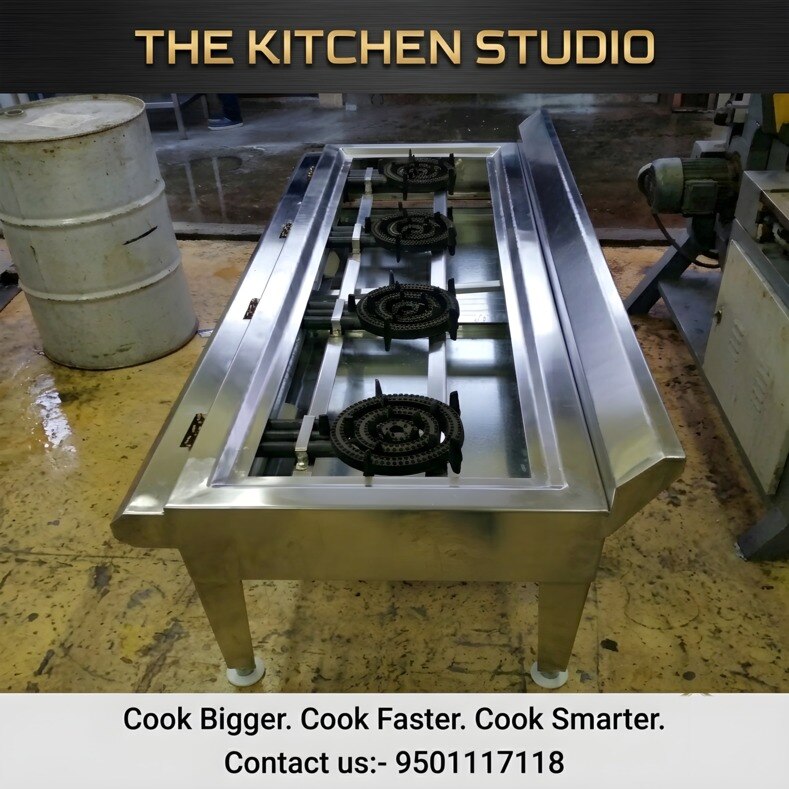
 | Stainless Steel Burner Range The stainless steel burner range is designed for high-performance cooking in commercial and professional kitchens. View product → |
Frequently asked questions
How do you measure whether a 4-burner range can handle restaurant volume?
Count the pans active during your busiest service, then compare that requirement with usable pan space, burner output and recovery speed.
What must you confirm before ordering a commercial gas cooking range?
Confirm the available gas type, supply pressure, pipe capacity, exhaust hood and make-up air requirements with qualified installers.
Which range features make daily cleaning easier?
Specify stainless steel construction, removable grates, accessible spill areas, sealed joints where appropriate and dimensions that allow full wipe-down access.
How should you document a commercial cooking range purchase?
Record burner output, gas type and pressure, overall and working dimensions, pan capacity, ventilation needs, materials, safety controls and service requirements.