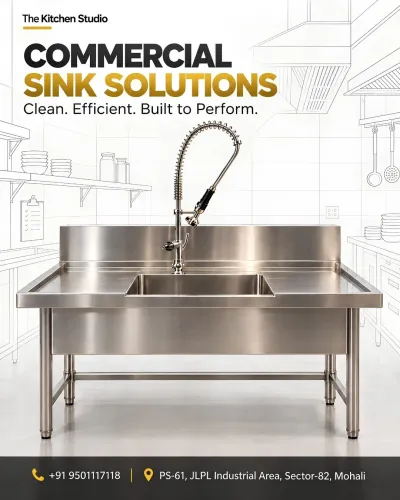

Dishwashing and food preparation areas can quickly become bottlenecks when commercial kitchens lack appropriate sink capacity. Commercial 3-Compartment Stainless Steel Sinks provide three separate working sections that can support organized washing, rinsing, sanitation procedures, and other kitchen tasks depending on the establishment's operating process.
Restaurants, hotels, cafés, institutional kitchens, and catering facilities should select these sinks according to workload rather than simply choosing a standard size.
Understand the Three-Compartment Layout
The three-bowl configuration provides separate spaces within one continuous workstation.
Depending on kitchen procedures, individual compartments can be allocated to different stages of utensil handling. Separation helps staff follow a consistent workflow instead of repeatedly emptying and refilling a single sink.
The configuration can also be useful where different preparation activities need dedicated washing areas.
Match Bowl Size to Utensils
A sink may have three compartments but still be inconvenient if the bowls are too small for the utensils used in the kitchen.
Operators should consider their largest frequently washed vessels, trays, containers, and cookware.
Commercial kitchens in Punjab that handle large-volume Indian cooking may use substantial pots and preparation vessels, making bowl depth and width especially important.
Evaluate Stainless Steel Construction
Commercial sinks are exposed to constant water, cleaning chemicals, food residue, and repeated handling.
Stainless steel is widely used because its smooth surface supports cleaning and withstands demanding kitchen environments when maintained appropriately.
Buyers should inspect the overall fabrication, edges, joints, legs, and support structure. A sink used for heavy vessels should remain stable during everyday operation.
Consider Drainage and Plumbing
Drain positioning can influence how efficiently water leaves each compartment.
Before installation, the plumbing layout should be checked to ensure connections can be made without creating unnecessary obstructions beneath the sink.
The floor drainage system around the washing area also deserves attention because wet floors can interfere with staff movement.
Add Useful Working Surfaces
Drainboards can provide space for stacking dirty utensils before washing and placing clean items afterward.
Depending on the available space, a sink may include one drainboard, two drainboards, undershelves, or adjacent storage.
These features should support the intended workflow rather than unnecessarily increasing the equipment footprint.
Position the Sink Strategically
The washing section should be separated appropriately from food production while remaining convenient for staff.
Dirty utensils should be able to reach the washing area without repeatedly crossing clean preparation zones.
The Kitchen Studio provides stainless steel commercial kitchen equipment and setup solutions for food-service operations. When specifying sinks, the provider can consider kitchen dimensions, utensil volume, washing practices, and surrounding equipment as part of the overall planning process.
A three-compartment sink is a relatively simple piece of equipment, yet its dimensions and placement can have a noticeable impact on daily kitchen efficiency.
Selecting the correct bowl size, construction, drainboard arrangement, and installation location helps create a washing station that supports smoother movement and easier cleaning throughout busy service periods.
Keywords